What to do when your car floods out or gets stuck in mud
New Orleans's drainage pumps can't outrun an ordinary summer storm, and half the city sits at or below sea level. First step: stop making it worse.
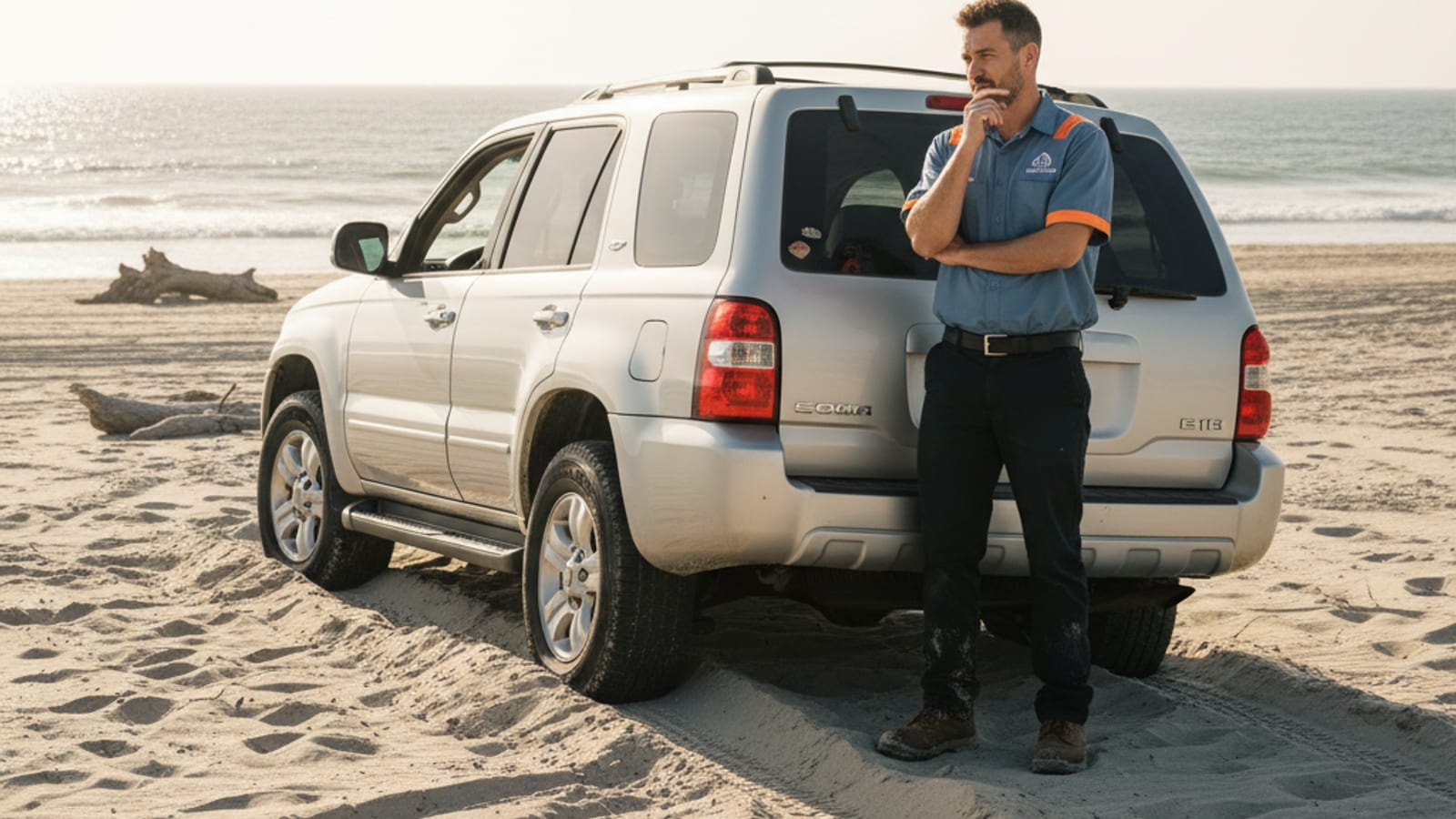
What you'll learn
- Why spinning the wheels digs you in deeper, fast
- Why you should never try to restart a car that stalled in standing water
- How traction mats work and when to use them
- Why New Orleans floods on an ordinary Tuesday, not just during a hurricane
- When to stop trying and call a winch-out
Step by step
- Stop spinning the wheels immediately. Every few seconds of spin sinks you further.
- Check that no one is hurt and the vehicle is not unstable before doing anything else.
- If the car stalled in standing water, do not try to restart it. Cranking a flooded engine can cause catastrophic damage.
- If it is safe to do so, clear mud away from the front and back of each drive wheel.
- Slide traction mats, cardboard, or floor mats under the drive wheels for a soft-shoulder or mud situation.
- If it does not move after 2 careful tries, stop. Call for a winch-out.
Half of New Orleans sits at or below sea level, and the Sewerage and Water Board's drainage pump system, 24 pumping stations running 120 pumps, some more than a century old, can't keep pace with an ordinary summer downpour. The Carrollton Ave underpass and Claiborne Ave in Uptown are chronic repeat-offender flood points; the city has closed both directions of Carrollton during storms before. A winch-out is far cheaper than a hydrolocked engine. The operators we dispatch carry recovery mats and winch rigs on the truck.
Why this happens on an ordinary Tuesday, not just during a hurricane
Roughly half of New Orleans sits at or below sea level, and the city relies on a drainage system built more than a century ago to keep up. The Sewerage and Water Board of New Orleans (SWBNO) runs 24 drainage pumping stations housing 120 drainage and constant-duty pumps, plus 12 smaller automatic underpass stations that kick on when water starts rising, moving stormwater through roughly 90 miles of open canals and another 90 miles of canals running underground. That system was designed for a smaller, less-paved city than the one it protects today. A hard summer thunderstorm can put standing water in the street faster than the pumps can move it out, on a random Tuesday in July with no named storm anywhere near the Gulf.
The city's chronic flood points
Some spots flood first and worst, every time. The Carrollton Ave underpass at the I-10 overpass is a well-known repeat offender - the city has closed both directions there during heavy storms rather than let drivers push through. Claiborne Ave in Uptown floods regularly too, tied to catch-basin issues and high water backing up in the Palmetto Canal. Low-lying, bowl-shaped neighborhoods built on old backswamp ground - Broadmoor, Mid-City, parts of Gentilly - fill with standing water fastest because that's literally the low point water drains toward.
Never restart a car that stalled in standing water
If your engine died while you were driving through water, do not turn the key again. An engine draws air in through the intake, and if the intake is sitting below the waterline, cranking the starter pulls water into a cylinder instead of air. Water does not compress the way an air-fuel mixture does, so when the piston comes up to compress it, something has to give - usually a bent connecting rod or a cracked engine block. That single extra crank is often the difference between a car that needs a tow and a car that needs a new engine.
Salvage assessment or a normal tow? What decides it
How high the water got is what matters, not how deep it looked from the driver's seat. If water reached the door sills, the floorboards, or higher, treat this as a flood-damage assessment, not a routine breakdown - get the vehicle to a shop or your insurer's preferred facility for inspection before anyone tries to start it, and let them check the engine, transmission fluid, and electrical system before you spend a dollar on repairs. If the water only came up around the tires and the engine never took a breath of it, this is usually a normal stuck-vehicle recovery and tow, nothing more.
Hurricane flooding vs. an ordinary summer downpour
Hurricane Katrina put more than 80% of the city under water in 2005 after 53 separate levee and floodwall breaches. Hurricane Ida knocked out power to roughly a million Louisianans in 2021 and took about 10 days to substantially restore across New Orleans. Those are the storms everyone remembers, but the same standing-water risk shows up on a much smaller scale nearly every summer, June through September, whenever an afternoon storm outruns the pump stations. A car stalled at Carrollton and Claiborne on a Tuesday afternoon in August is dealing with the exact same physics as a car stalled during a named storm - it just doesn't make the news.
Why operators usually use a flatbed on a flood-affected vehicle
A vehicle that sat in standing water, even briefly, may have compromised brakes, a soaked electrical harness, or water in places you cannot see from outside. Operators we match typically discuss a flatbed for flood recovery rather than a wheel-lift, so nothing is asked of a drivetrain that might already be damaged. Ask that operator what they will use before they hook up. We do not own the trucks.
Rather have a pro handle it?
Towing and roadside service across the New Orleans metro. One local line, taking calls 24/7.
Keep learning.
Jump-start a dead battery safely
Jumper cables are simple until you hook them wrong. Do it right and you'll avoid sparks, ruined electronics, and a tow you didn't need.
Change a flat tire on the side of the road
The difference between a 20-minute shoulder stop and an hour on the phone with a tow company is knowing where the spare and jack live before you need them.
Prepare your vehicle for a tow
A few minutes of prep before the tow truck arrives saves time, avoids damage, and makes the whole call go faster.